🤖 Architectural Comparison: Agent Runtime vs. Single-Shot LLM Execution
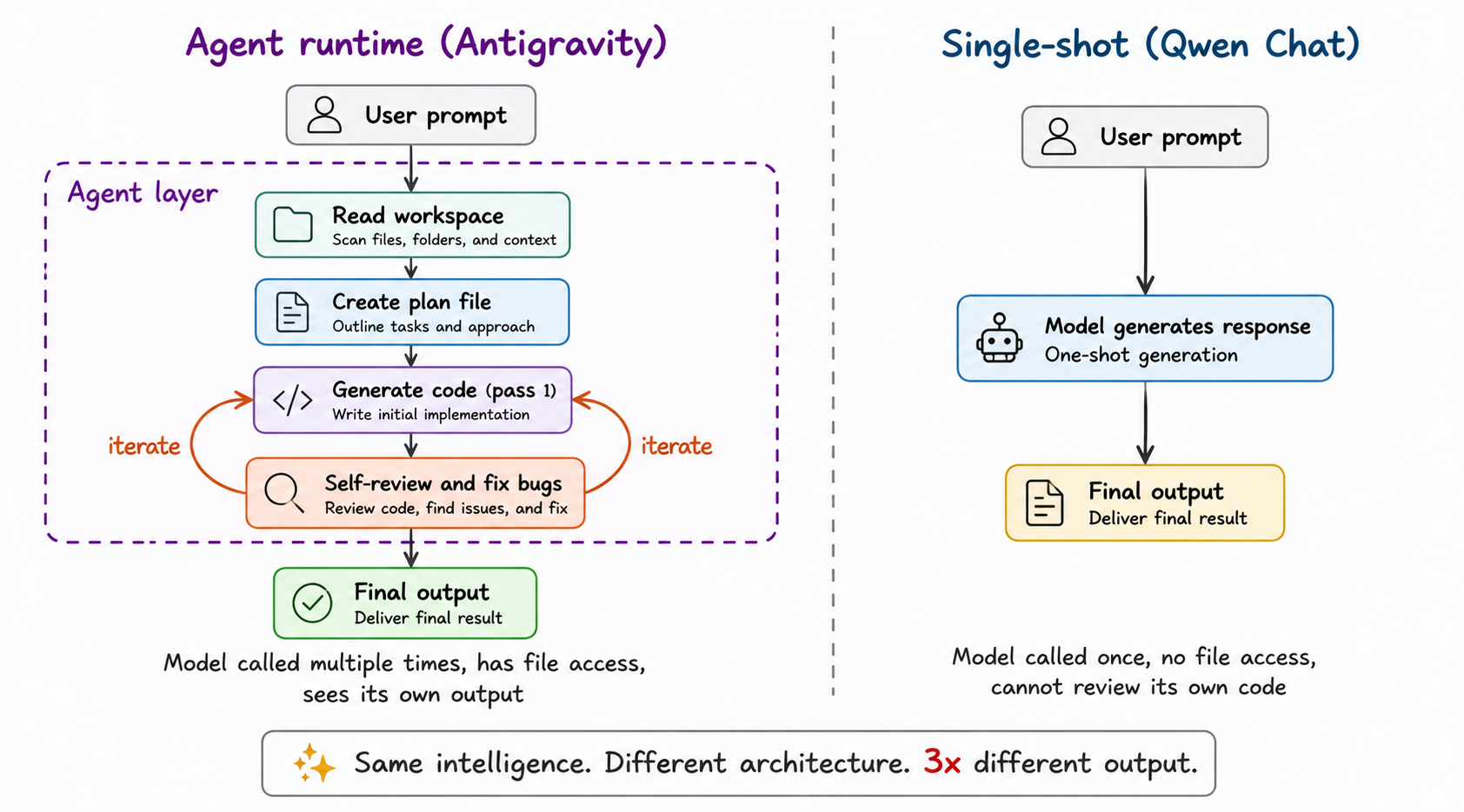
Core Insight: Same intelligence. Different architecture. 3x different output.
1. Overview of the Architectures
🤖 Architecture A: Agent Runtime (Antigravity)
An iterative, multi-step system where the LLM is embedded within a programmatic control loop (the "Agent layer"). It mimics a human software engineering workflow by breaking tasks down and self-correcting.
-
Workflow Flowchart:
User prompt➔Read workspace➔Create plan file➔Generate code (pass 1)➔Self-review & fix bugs (Iterate)➔Final output -
Key Capabilities:
- Multi-turn Invocation: The model is called multiple times throughout the execution cycle.
- Workspace Awareness: Has active file access to read existing codebases and context.
- Feedback Loops: Uses a self-correction mechanism to iterate on code generation and bug fixing before finalizing.
⚡ Architecture B: Single-Shot (Qwen Chat)
A traditional, direct input-output interaction model typical of standard chat interfaces.
-
Workflow Flowchart:
User prompt➔Model generates response➔Final output -
Key Capabilities:
- Single-turn Invocation: The model is called exactly once per request.
- Isolated Environment: No system file access or workspace context awareness.
- Static Generation: Cannot review, test, or self-correct its own code prior to outputting.
2. Comparative Analysis
| Dimension | Agent Runtime (Antigravity) | Single-Shot (Qwen Chat) |
|---|---|---|
| Model Invocations | Multiple times per task (Iterative) | Single time per task (Linear) |
| Context Integration | High (Reads & updates workspace files) | Low (Limited to the immediate prompt) |
| Self-Correction | Yes (Autonomous test, review, and edit) | No (Output is final on the first pass) |
| Computational Cost | High (Multi-token, multi-turn overhead) | Low (Single generation cost) |
| Output Quality | Significantly higher (3x improvement) | Baseline model capability |
3. Advantages & Disadvantages (Pros & Cons)
🔍 Expand Details: Agent Runtime (Antigravity)
👍 Pros
- Drastically Higher Code Quality: The iterative self-review loop minimizes syntax errors, logical bugs, and edge-case failures, yielding up to 3x better results.
- Contextual Relevance: File system access allows the agent to understand existing project structures, frameworks, and coding standards, leading to highly integrated solutions.
- Autonomy in Planning: Creating an explicit plan file before coding forces the system to map out dependencies and architecture, reducing erratic generation.
- Handling Complexity: Well-suited for large-scale tasks that require multi-file edits or complex refactoring.
👎 Cons
- High Latency: Because it involves multiple internal iterations and self-review steps, the time to return the final output is substantially longer.
- Increased API Costs / Resource Intensive: Multiple model calls and expanded token usage (from reading workspaces and processing logs) significantly drive up computational costs.
- Risk of Infinite Loops: If the self-review mechanism fails to correctly resolve an error, the agent can get stuck iterating indefinitely without human intervention.
🔍 Expand Details: Single-Shot (Qwen Chat)
👍 Pros
- Near-Instantaneous Response: Provides immediate feedback, making it ideal for quick lookups, simple queries, or rapid brainstorming.
- Highly Cost-Effective: Minimizes token utilization and computational overhead by executing only a single pass.
- Simplicity: No specialized software layer or file system integration needed; straightforward plug-and-play architecture.
👎 Cons
- Lower Success Rate on Complex Tasks: Lacks the ability to double-check its work, making it highly prone to hallucinations, bugs, and incomplete code blocks.
- Blind to Project Context: Cannot read local workspaces autonomously; relies entirely on the user manually copying and pasting context into the prompt window.
- Brittle Output: If the first generation contains a minor syntax error, the output is broken, requiring the user to manually prompt it again to fix it.
4. Key Conclusion
Increasing the raw size or intelligence of an underlying foundational model is not the only path to better performance. Programmatically wrapping an existing model in an Agent Runtime structure—granting it execution memory, file access, and self-evaluation capabilities—unlocks vastly superior real-world utility compared to utilizing the exact same model in a Single-shot context.